.avif)

Get started with 10,000 free minutes
Sign up and start building! You don’t pay until you scale.


Agora, our operating systems, and environment have received ISO and SOC 2 certifications and are HIPAA, GDPR, and CCPA compliant. Ensure secure, enterprise-grade real-time collaboration software with strong data protection and privacy controls.


.svg)


.svg)
.svg)
.svg)


.svg)

.png)


.png)
.png)

Agora Voice Calling is a real-time voice API that lets developers embed high-quality, ultra-low latency voice chat into any application. It supports one-to-one calls, group voice chat, and large-scale audio rooms across devices and platforms.
Agora Voice Calling supports Android, iOS, Web, Windows, Electron, Flutter, React Native, Unity, and Unreal Engine. This allows teams to build consistent voice experiences across mobile, web, desktop, and immersive environments.
Agora uses a 48 kHz sampling rate with full-bandwidth audio capture and intelligent routing over its global real-time network. This minimizes latency, jitter, and packet loss to deliver clear, stable voice calls—even on unstable networks.
Yes. Agora Voice Calling includes AI-powered features such as Noise Suppression, Real-Time Speech to Text, and seamless integration with large language models and text-to-speech engines to enable intelligent, voice-driven experiences.
Yes. Agora supports flexible voice recording in the cloud or on premises. Developers control audio formats, storage locations, and recording quality to support playback, analytics, moderation, or compliance needs.
3D Spatial Audio simulates real-world sound positioning, making conversations feel more immersive and natural. It’s commonly used in gaming, social audio rooms, virtual workspaces, and metaverse-style experiences.
You can integrate Agora Voice Calling within hours using SDKs, documentation, and sample apps. For teams that want to move faster, Agora App Builder offers a no-code option to deploy voice chat without custom development.
Agora Voice Calling is ideal for education platforms, multiplayer games, social apps, collaboration tools, live shopping, customer engagement, and IoT devices—any use case that requires reliable, real-time voice communication at global scale.
Agora Video Calling is a real-time video API that lets developers embed high-quality, low-latency video calls into web, mobile, and native applications. It supports everything from 1:1 calls to large-scale video experiences with full customization.
Agora Video Calling supports Android, iOS, Web, Windows, Electron, Flutter, React Native, Unity, and Unreal Engine—making it easy to deliver consistent video experiences across devices and operating systems.
Agora uses intelligent routing and adaptive video optimization to reduce jitter, lag, and packet loss. The platform dynamically adjusts video quality in real time to maintain smooth, uninterrupted calls—even on slow or unstable networks.
Agora supports advanced collaboration features such as screen sharing, interactive whiteboards, multi-user video layouts, and real-time messaging. These features make it well suited for meetings, education, telehealth, and collaborative work apps.
Yes. Agora provides flexible video call recording options, allowing you to record securely to the cloud or on local servers. Developers control video format, resolution, storage location, and access permissions to meet compliance and operational needs.
Yes. Agora supports multi-track audio and video, making it possible to publish multiple camera feeds or microphone streams within a single session. This is ideal for live production workflows, virtual events, and advanced conferencing scenarios.
You can ship a video calling app within hours using Agora SDKs, documentation, and sample apps. For even faster deployment, Agora App Builder provides a no-code option to launch video, voice, and live streaming features without custom development.
Agora Video Calling is ideal for education, remote work, gaming, social apps, live shopping, and telehealth. Any application that requires scalable, real-time video communication with global reach and low latency can benefit from Agora’s platform.
Agora Real-Time Chat is a customizable chat SDK that lets developers add secure, scalable messaging to real-time video, voice, and live streaming applications. It supports one-to-one messaging, group chat, and large community channels.
Agora’s Chat SDK supports Android, iOS, Web, Windows, Flutter, React Native, and Unity, making it easy to deliver consistent messaging experiences across mobile, desktop, and cross-platform apps.
Agora Chat supports rich media messaging including emojis, images, files, GPS locations, structured messages, and voice notes. Core messaging features also include offline messaging, message recall and deletion, read receipts, typing indicators, presence, and push notifications.
Agora Chat uses TLS/SSL encryption for data in transit and encrypted file storage to protect user data. The platform also supports privacy compliance features such as user data deletion and secure message handling.
Yes. Agora Chat includes built-in content moderation to help filter profanity, offensive language, and inappropriate images or text. Developers can also integrate third-party moderation tools for additional control.
Yes. Agora Chat supports multilingual message translation with automatic, on-demand, or push-based translation options, enabling users to communicate in their preferred language.
Developers can launch a chat experience within hours using Agora SDKs, documentation, and sample apps. For faster implementation, Agora UI Kit provides a low-code option to add messaging with minimal development effort.
Agora Real-Time Chat is ideal for education platforms, gaming communities, social apps, collaboration tools, live commerce, and telehealth—any application that requires reliable, secure, and engaging real-time messaging.
Agora Real-Time Speech to Text is a cloud-based live transcription and subtitling service that converts real-time audio into accurate text for live audio and video applications. It enables captions, transcripts, and AI-powered workflows without impacting real-time performance.
Agora’s cloud-based transcription processes audio streams in real time and converts speech into text with low latency. Transcripts can be delivered as live captions to participants, stored for later review, or exported for downstream processing.
Yes. Real-time transcripts can be integrated with large language models to generate summaries, meeting notes, action items, feedback, or translations. Transcripts can also be exported as .vtt files for seamless LLM processing without affecting RTC performance.
Yes. Agora supports real-time speaker recognition and labeling for up to three simultaneous speakers. Each speaker can be transcribed separately, improving accuracy in conversations with interruptions or overlapping dialogue.
Agora supports all major languages and regional dialects. Each channel can transcribe up to two languages simultaneously, making it ideal for multilingual meetings, events, and global applications.
Yes. Agora supports transcription for cloud-recorded audio and video, enabling closed captions (CC) during playback and searchable transcripts for reviewing important discussion points.
Agora uses advanced AI techniques to reduce silence, lower Word Error Rate (WER), and maintain accuracy even with accents, overlapping speech, poor audio quality, or unstable networks. The solution scales from one-to-one sessions to millions of participants with consistent accuracy.
Yes. Agora is ISO and SOC 2 certified and supports compliance with GDPR, CCPA, and HIPAA. Live captions and transcripts can be encrypted using the same security mechanisms as Agora’s real-time audio and video streams.
Agora Recording is an extension that allows developers to record audio streams, video streams, interactive content, and web pages for archive, review, compliance, or redistribution. It supports cloud, on-premises, and webpage recording options.
Agora Recording can capture audio, video, screen content, whiteboards, chat messages, and live streaming elements. You can record single streams or multiple streams separately, making it easy to edit, combine, or repurpose content later.
Single-stream recording combines audio, video, and content into one synchronized file. Multi-stream recording captures each audio, video, or content stream separately, giving you greater flexibility for post-production, analysis, or moderation workflows.
Recordings can be stored in the cloud or on-premises, depending on your deployment needs. Agora supports third-party cloud storage providers such as Amazon S3, Microsoft Azure, Google Cloud, Alibaba Cloud, Tencent Cloud, and others.
Yes. Agora Recording supports screenshots for moderation, customizable capture intervals, digital watermarks, and content moderation tools. These features help enforce community guidelines, protect intellectual property, and meet regulatory or organizational requirements.
Agora Recording is built with enterprise-grade security, including end-to-end encryption for calls, transmission, and storage. It supports globally distributed clusters, automatic backups, proxy services, and LAN deployment to meet strict data security and privacy needs.
Developers can integrate Agora Recording in as little as 30 minutes using RESTful APIs. The service is designed to be easy to embed, test, and deploy, with automatic uploading and backup to ensure recordings are not lost.
Agora Recording is ideal for virtual events and webinars, large-scale live streaming, customer service quality assurance, education and online classes, and telehealth consultations—any scenario where capturing, reviewing, or distributing real-time interactions is essential.
Agora’s Broadcast Streaming API is a scalable live streaming API for one-to-many streaming use cases such as live events, webinars, gaming, and media broadcasts. Built on Agora’s global Software-Defined Real-Time Network (SD-RTN®), it delivers high-quality audio and video to large audiences with ultra-low latency and high reliability, while handling routing, scaling, and network optimization automatically.
Agora’s low-latency streaming is powered by its global Software-Defined Real-Time Network (SD-RTN®), which dynamically routes traffic across distributed edge nodes to maintain optimal performance. Intelligent congestion control, real-time monitoring, and adaptive bitrate delivery help reduce buffering, packet loss, and delay. This architecture ensures synchronized audio and video playback worldwide, even under challenging network conditions.
Yes. Agora’s live streaming infrastructure is built for massive concurrency and automatic scaling. The global SD-RTN® network dynamically allocates resources and routes traffic across distributed edge locations to maintain consistent performance, even during large spikes in viewership.This makes it ideal for large-scale events, live commerce, social streaming, gaming, and media broadcasts.
Agora’s Broadcast Streaming API includes enterprise-grade security features such as AES-128/256 encryption, token-based authentication, and geofencing controls. These capabilities help prevent unauthorized access and protect confidential data during transmission. Developers can also integrate additional third-party security services to meet specific compliance or regulatory requirements.
Broadcast Streaming is designed for one-to-many delivery, where a host streams content to a large audience with limited real-time interaction. It prioritizes scale, stability, and consistent playback quality. Interactive Live Streaming supports real-time participation, enabling features such as co-hosting, live audience interaction, voice or video calls, and multi-participant sessions. Built on Agora’s real-time network, interactive streaming provides ultra-low latency communication while still supporting large audiences. Broadcast Streaming is ideal for large events and presentations, while interactive streaming enables deeper real-time engagement.
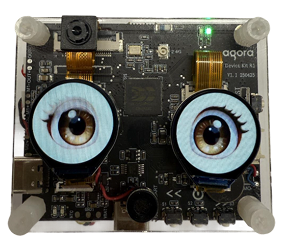
A conversational AI device kit is a hardware and software development platform that allows developers to embed real-time voice interaction into physical products. It combines microphones, connectivity, processing modules, and AI SDKs so devices can understand speech, interpret intent, and respond naturally using large language models (LLMs), speech recognition (ASR), and text-to-speech (TTS).
Yes. The Convo AI Device Kit supports integration with custom large language models and third-party AI services. Developers can connect their preferred cloud LLM provider or private model through APIs, allowing full control over responses, data handling, and device behavior.
The conversational AI device kit supports hybrid processing. Latency-sensitive audio processing and wake-word detection can run locally on the device, while advanced conversational reasoning typically runs through connected cloud AI services. This architecture balances responsiveness with powerful language understanding.
Developers can build applications using standard SDK integrations and APIs compatible with common languages such as C/C++, Python, JavaScript, and other platform-supported environments depending on the device firmware and connected cloud services.
Developers can create a working conversational demo in about one hour and a production-ready prototype within a day. The pre-integrated hardware, SDKs, and connectivity eliminate complex setup and significantly reduce development time compared to building from scratch.
Agora Interactive Live Streaming is a real-time streaming SDK and API that enables ultra-low latency video, voice, and chat so hosts and audiences can interact live without noticeable delay. It is designed for applications that require real-time engagement rather than traditional broadcast-only streaming.
Traditional live streaming often has multi-second delays that make real-time interaction awkward. Agora is built for sub-second latency, enabling features like live co-hosting, audience “raise hand” participation, chat reactions, and virtual gifting with near real-time synchronization.
Yes. Agora supports dual-stream and adaptive bitrate streaming, allowing high- and low-bitrate video to be delivered simultaneously. This ensures viewers on different devices and network conditions can receive a smooth, optimized experience.
Agora supports interactive features such as multi-host streaming, real-time chat, audience participation, screen sharing, virtual gifting, and media extensions. Developers can also enable advanced capabilities like noise suppression, spatial audio, real-time transcription, and visual effects using built-in SDK extensions.
You can build with Agora’s SDKs for full customization across platforms, or use Agora App Builder for a faster, no-code path to launch live streaming with real-time voice, video, and interactive features.
Agora AI Noise Suppression is a real-time audio enhancement extension that removes background noise, unwanted disturbances, and natural interferences during voice and video calls. It helps ensure that the speaker’s voice remains clear and intelligible, even in busy or unpredictable environments such as homes, offices, public spaces, or live event settings.
Agora AI Noise Suppression is trained on deep learning models that can reduce or eliminate more than 100 types of background noise. This includes common distractions such as keyboard typing, mouse clicks, fans, traffic sounds, background conversations, and crying babies. By isolating and prioritizing the human voice, it helps maintain a focused and professional communication experience.
Yes. In addition to background noise removal, Agora’s sound processing technology reduces echo and reverberation that can occur in rooms with poor acoustics. This improves overall speech clarity and ensures conversations sound more natural and polished, whether users are in small meeting rooms or large open spaces.
AI Noise Suppression is optimized for low latency processing so that real-time communication remains smooth and responsive. It is designed to operate efficiently without adding noticeable delay, preserving natural conversation flow during live calls, interactive streaming sessions, gaming voice chat, and virtual events.
Integration is simple and modular. Developers can enable background noise filtering by calling the appropriate API with only a few lines of code. The extension can also be activated through the Agora Console, allowing teams to implement advanced real-time audio cleanup quickly without significant changes to their existing architecture.


