
Behind a good voice conversation, several smaller jobs may be running: classifying intent, extracting a name, retrieving account data, compressing history, and choosing the model for the next step. Using one model for every job keeps the architecture simple, though it may add cost, latency, and variability.
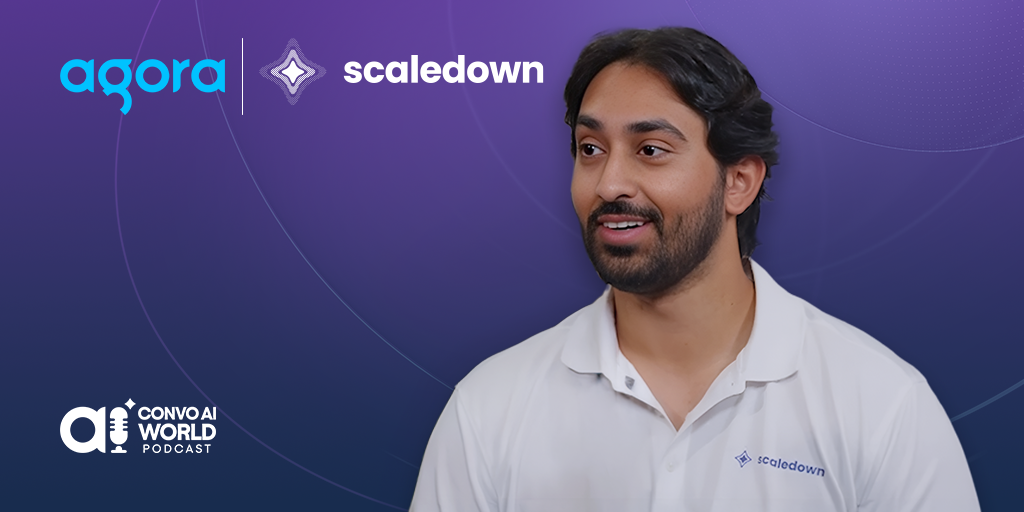
In this episode of the Convo AI World Podcast, I spoke with Neal Patel, co-founder of ScaleDown, about task-specific small language models. Neal's interest began while forecasting data-center demand at Accenture. Even on long planning horizons, demand for AI compute kept outpacing available hardware. That pushed him to study how models could use fewer tokens and less compute while still doing a defined job well.
What stood out to me was the division of labor Neal described. ScaleDown keeps a capable general model in the conversational role and uses smaller specialists around it. That approach is especially relevant to voice AI, where one model may speak with the caller while several others work quietly in the background.
Specialization Changes the Model Architecture
ScaleDown builds models for classification, extraction, summarization, and compression. Neal explained that the company retains an open model's input representation and replaces its general-purpose decoder with a neural head for a specific task. A classifier selects from predefined labels; an extraction model returns specified entities and their source citations. Neither requires open-ended generation.
The tradeoff is deliberate. A model built to summarize documents cannot suddenly write code or plan a trip. However, within its assigned task, ScaleDown says the smaller architecture can improve speed, cost, and consistency. Neal also noted that most customers start with ScaleDown's base models rather than commissioning a model for every workflow.
Keep Broad Reasoning in the Conversation
For a live voice agent, Neal recommends using the strongest general model that meets the product's latency requirements as the orchestrator. That model handles the unpredictable aspects of the experience: understanding a person, deciding what to do next, and keeping the conversation coherent.
Task-specific models are deployed at the subagent layer. They can run in parallel to extract a patient's name, classify a document, route a request, or prepare backend data. The orchestrator receives the result without spending its own time and tokens on each supporting step. That point landed for me because the efficiency gains may come from the work surrounding the conversation rather than from the model speaking to the user.
Compression Keeps the Useful Context
ScaleDown's compression model targets a different source of waste. Retrieval can return a large volume of relevant-looking material, but much of it may still be noise for the question at hand. ScaleDown places a query-aware compression step between retrieval and the main model. It retains the passages needed for the answer and removes material unlikely to help.
Neal said ScaleDown has seen input-token reductions of 30 to 50 percent in these workflows, with even higher reductions in some cases. He also cited accuracy gains of 7 to 10 percent on the company's finance and needle-in-a-haystack benchmarks after low-signal context was removed. The same idea applies to a long voice conversation. Periodic compaction can preserve names, decisions, and open questions while dropping filler and tangents that no longer matter.
Post Call Analysis Needs Consistent Outputs
Once a call ends, latency matters less, but volume rises quickly. A team may need to classify outcomes, extract fields, tag several themes, or compare thousands of transcripts. Neal said ScaleDown commonly sees 10 to 15 percent variance in output when a general generative model repeats a narrow classification task. At that scale, the uncertainty makes aggregate results harder to trust.
A task-specific classifier narrows the output space. It can support binary decisions, a single choice among several classes, or multiple labels on the same call. Neal was careful to note the limit of this approach: ScaleDown's models are not deterministic. They are designed to reduce variance on defined tasks, giving teams a more stable foundation for quality review and post-call analysis.
Model Choice Becomes Part of the Architecture
Routing turns model choice into a workflow step. One classifier can select the model for a request; another can evaluate the result against a known standard. Neal identifies four useful starting points: routing, specialist subagents, post-call processing, and evaluations. Teams can start where inconsistency or compute cost is already affecting the product.
I came away with a straightforward test: define the job before choosing the model. A frontier model may be right for live orchestration. A task-specific model may be better for routing, extraction, compression, or evaluation. The architecture improves when each model has a job it can perform reliably.
The full episode covers ScaleDown's model architecture, query-aware compression, parallel subagents, multimodal classification, evaluations, deployment options, and Neal's view of where agent orchestration is heading.
Watch the ScaleDown episode here: https://www.youtube.com/watch?v=JeRnO5dMyeY
Ready to build
- Explore: Agora Conversational AI Engine
- Learn: The Anatomy of Voice AI Agents
- Join: Our Developer Community on Discord


