
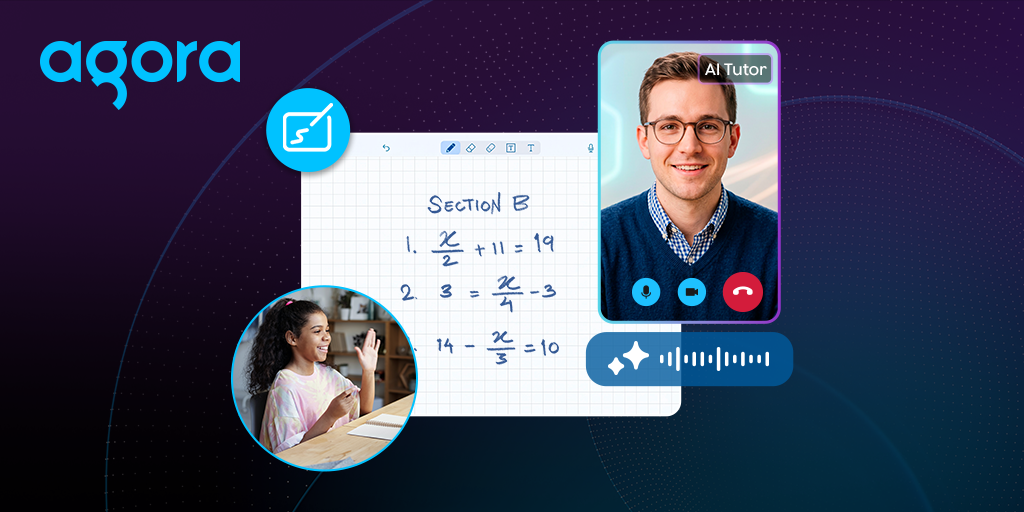
The Scaling Problem in Student Services
Educational institutions and EdTech platforms are exploring new ways to offer personalized student support at scale. By extending access beyond traditional office hours, they can give students timely answers and engaging experiences without adding headcount at the same pace.
Avatars powered by artificial intelligence (AI), or digital humans, offer one way to deliver those experiences. These voice-and-video agents can hold live, natural conversations with students around the clock. They work as an extension of your educational staff, handling the repetitive parts of student support, so your staff can focus on the cases that need a human touch.
Here, we walk through where digital humans fit in student services. We discuss what makes them feel conversational and how Agora’s real-time network makes that possible.
What Are AI Avatars in Education?
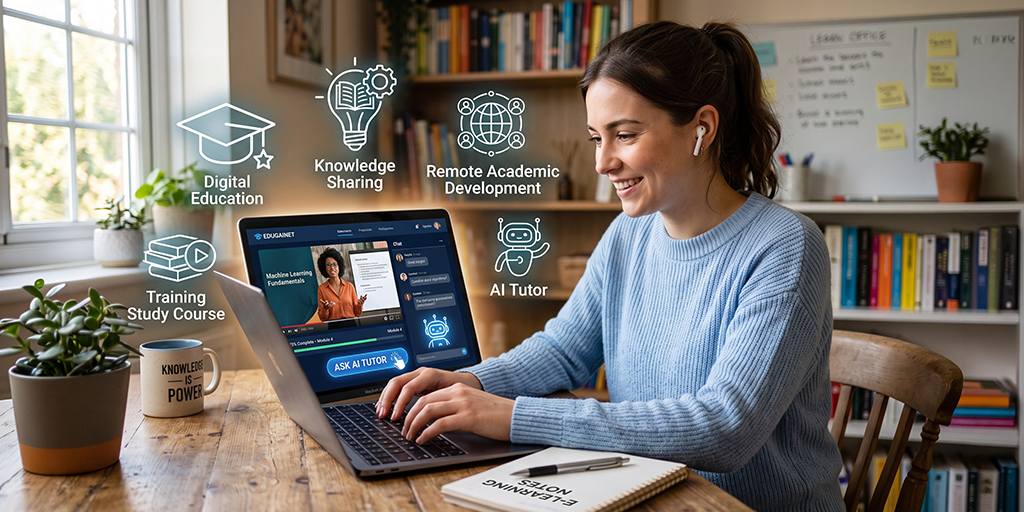
A digital human is a visual, voice-driven agent that holds a live, two-way conversation. This is different from a static text chatbot that uses a request-response loop with a delay. A digital human is expected to listen, respond, and adjust mid-sentence, the same way a person would. It uses a stack of specialized pieces that work together:
- A large language model (LLM) or small language model (SLM) reasons and generates responses
- Automatic speech recognition (ASR) turns student speech into text
- Text-to-speech (TTS) turns the LLM’s response into voice
- Real-time transport layer (RTL), such as Agora, moves audio and video between student and agent with minimal delay
Over the last few years, AI technology has improved enough that these technologies can now be orchestrated reliably enough for institutions to deploy them at scale to expand student services, without adding staff or overworking existing teams.
Core Use Cases: Where Digital Humans Fit in Student Services
Like real humans, digital humans are adaptable. The same stack can take on different roles depending on where an institution’s human capacity is most stretched. However, there are a few places where they tend to have the most impact:
Digital Teachers
Digital teachers act as Socratic discussion partners and practice tutors, giving students a way to test their thinking outside of class hours. Rather than giving lectures, the avatar debates a concept, questions a weak argument, or asks follow-up questions that force a student to articulate their reasoning. This extends instructors’ office hours for every student, and it gives students a lower-stakes way to work through material.
Academic Advisors
Academic advising avatars provide 24/7 guidance on course selection, registration deadlines, and career pathways. By handling these questions, human advisors can spend their limited hours on students on academic probation, transfer credit disputes, career pivots, and other cases that need human judgment.
Test Prep Coaches
As test prep coaches, digital humans give students an endless practice partner for exam prep. A student can rehearse an oral exam or a conversation in a new language as many times as it takes to feel ready, which isn’t always possible with human tutors.
Student Success and Counseling Support
In student success and counseling roles, a digital human acts as a judgment-free first point of contact for stress management and resource navigation. Whether it’s at 2:00 a.m. or on a weekend, a digital human is present when no one else is available, helping students talk through what they’re feeling and pointing them toward human support.
Admissions and Enrollment Guides
As admissions and enrollment guides, digital humans answer prospective students’ questions about the application process. Families researching programs late at night or in different time zones get an immediate conversation instead of a contact form. When students don’t have to wait multiple days for an answer, it improves their impression of your institution.
Across all five, digital humans augment staff capacity. They also close the confidence gap: students are more willing to ask a question, practice a skill, or admit confusion to an avatar first, before bringing it to a human.
How Agora’s Real-Time Infrastructure Makes Digital Humans Feel Human
The intelligence behind a digital human gets most of the attention. However, the quality of the conversation depends just as much on the infrastructure powering it.
A powerful language model can generate thoughtful responses, but it can’t control how quickly those responses reach the student. If speech lags, video freezes, or there are awkward interruptions, the conversation feels uncanny or robotic.
Real-time communication is an important part of the architecture behind digital humans because students don’t always speak in turns during conversations. They pause to think, interrupt with new questions, change their minds halfway through a sentence, or start talking before the avatar finishes responding. A digital human needs to handle those moments naturally if it’s going to feel like a real conversation instead of a scripted exchange.
Digital humans require low latency. Conversations begin to feel natural when round-trip latency stays below 300 milliseconds. Once delays become noticeable, students begin waiting for responses instead of interacting naturally.
A production-ready voice experience also needs to recognize when someone starts speaking, so it can stop the avatar at the right moment. This keeps audio and video synchronized throughout the conversation. That means your real-time layer should support:
- Ultra-low latency voice and video delivery
- Voice activity detection (VAD) to recognize when someone begins or finishes speaking
- Barge-in support so students can interrupt naturally without waiting for the avatar to finish
- Audio and video synchronization that matches speech to facial movements
- Global media delivery that provides a consistent experience for students around the world
- Infrastructure that scales from a small pilot to thousands of simultaneous conversations
This is where Agora comes in. Agora isn’t the AI model. It doesn’t replace your preferred LLM, speech recognition engine, or text-to-speech provider. Instead, it provides the real-time orchestration layer that brings those components together into a single conversational experience.
Agora is also model agnostic. Engineering teams can choose the AI services that fit their application today and swap them out as new models emerge. Because the communication layer stays the same, it’s easier to evolve your AI strategy without rebuilding every time. The result is a digital human that feels present, responsive, and ready for student interactions.
Ready to Build?
Institutions with the right infrastructure in place can offer every student always-on, one-on-one support that human staff alone cannot provide. Agora Conversational AI Engine gives education platforms the real-time infrastructure to deploy digital humans without the lag, dropped connections, or delays that make them feel less human or more robotic. Explore our SDKs or request a demo for your institution and start building for free today.


