
"The demo worked perfectly."
Then a customer interrupted the agent. Another called from a noisy restaurant. A tool call failed, the network slowed down, and an edge case nobody had written down suddenly became the entire customer experience.
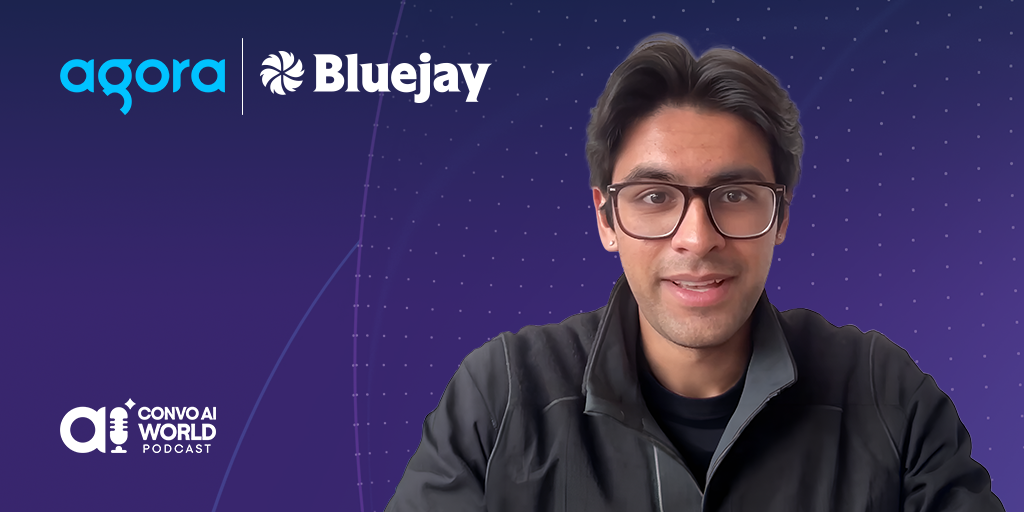
That gap between a controlled demo and a live conversation framed my discussion with Faraz Siddiqi, co-founder and CTO of Bluejay. His team did not set out to build a testing platform. They were building voice agents for restaurants and discovered that validating an agent could take longer than building it. Production was not the final step. It was where the real work began.
Ten Hours of Testing for One Agent
Restaurant calls look simple until you enumerate what can happen. An order may include substitutions, a reservation may change halfway through the call, and every spoken request must become the correct action in a point-of-sale system. Faraz's team was spending ten to twelve hours manually testing a single agent across these scenarios.
That experience changed Bluejay's direction. Instead of building another voice application, the team began building infrastructure that could test voice applications at production scale. The origin story matters because it keeps the product grounded in an operational problem: how do you prove that an agent will work before a real customer depends on it?
Digital Humans Make the Mess Reproducible
Bluejay's digital humans are simulated callers that can interrupt, use different accents, add background noise, experience poor network conditions, or become frustrated. Hundreds can call an agent in parallel. Scenarios that once consumed most of a workday can run in minutes, and teams can explore variations that a small manual QA group would never cover consistently.
The idea I liked most was not the scale of the simulation, but the feedback loop around it: every production failure should become tomorrow's test case. Bluejay's Replay feature recreates a failed interaction, so the team can reproduce the issue, fix it, and add it permanently to the regression suite. Over time, production stops being a stream of isolated surprises and becomes a source of better tests.
A Good Conversation Must Complete the Job
Faraz is careful not to reduce success to a single score. Latency, following instructions, and calling tools all matter, but only because they influence an outcome. A healthcare agent must schedule the right appointment. A restaurant agent has to capture the right order. If the conversation sounds polished but the downstream action is wrong, the agent has failed.
Latency illustrates the same point. A delay does more than make the agent feel slow. Once callers recognize that they are speaking with AI, they often shorten their answers and share less information. The system has changed the conversation it is trying to understand. Measuring milliseconds without measuring that behavioral effect misses part of the customer experience.
Do Not Automate Before You Have Intuition
Faraz offered an important counterweight to all this automation: early teams should still listen to customers and test manually. Those first conversations reveal the language, expectations, and failure modes that eventually shape a useful test suite. Automating too early can scale assumptions that the team has not yet earned.
Once that intuition exists, simulation, observability, heartbeat checks, and regression testing let teams move faster without treating reliability as an afterthought. This is voice AI adopting the discipline of modern software engineering, while acknowledging that conversations are less predictable than button clicks or API calls.
I left the conversation with a sharper definition of production readiness. It is not a demo that survives launch day. It is a system that learns from failure, tests the outcome that matters, and becomes harder to break with every real interaction.
The full episode explores digital humans, production observability, AI-ready developer documentation, and why Faraz believes conversational interfaces will reshape how people use software.
Watch the full episode here: https://www.youtube.com/watch?v=Z51U3CARzQQ
Ready to build?
- Explore: Agora’s Conversational AI Engine
- Learn: The Anatomy of Voice AI Agents
- Join: Our Developer Community on Discord


